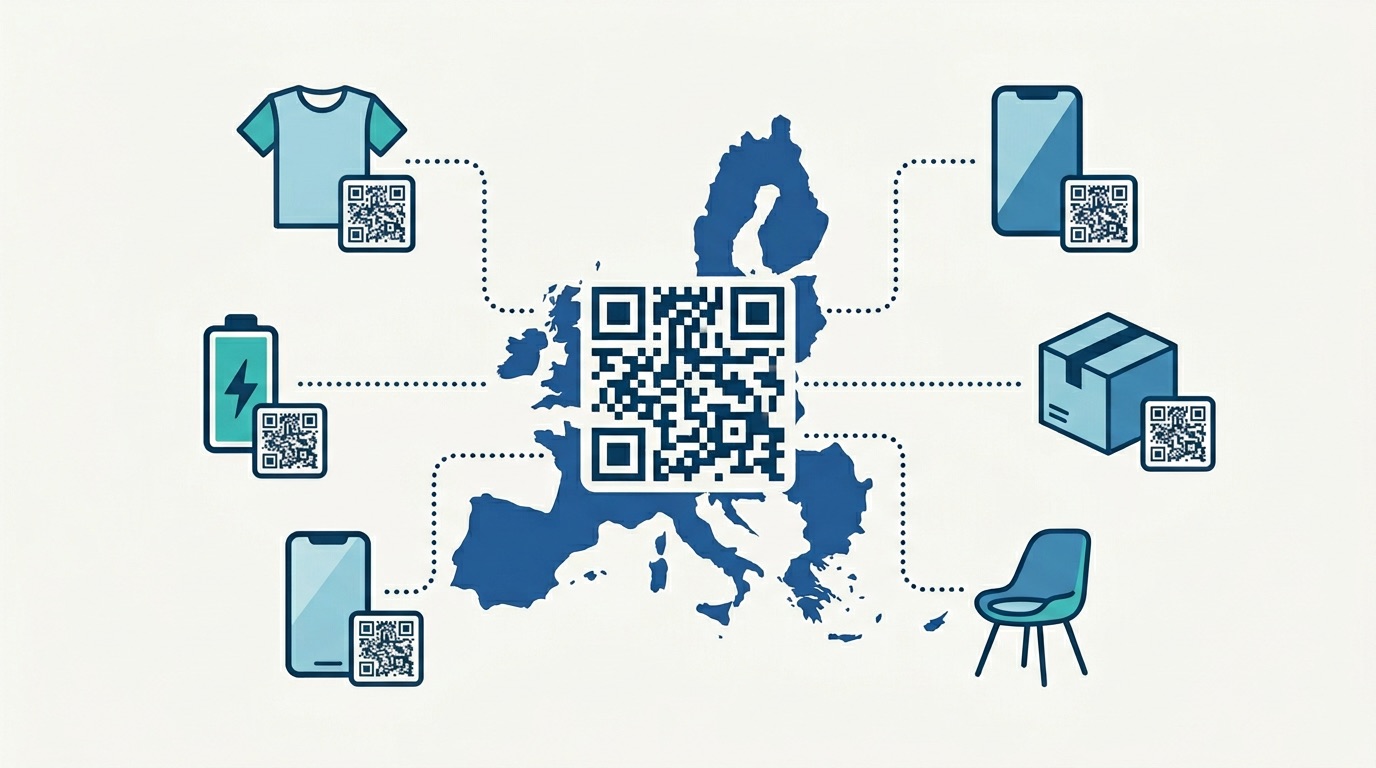

A sweeping new EU regulation is transforming how physical products carry and communicate information — and QR codes are at the center of it. The EU Digital Product Passport (DPP) requires manufacturers, importers, and retailers to attach a digitally linked identifier to every product sold in the European market, giving consumers, regulators, and supply chain partners instant access to verified lifecycle data: materials, carbon footprint, repairability, and recycling instructions. With 82% of companies currently unprepared for DPP requirements, and the first mandatory deadlines arriving in 2027, the window to plan and implement a compliant QR code strategy is now. Inriver's complete DPP implementation guide is a helpful companion resource for enterprise product teams building compliance programs.
This guide explains exactly what the EU Digital Product Passport is, which industries are affected and when, why QR codes are the primary data carrier, what data must be included, and how to build a scalable, compliant QR code program using standards-based tools.
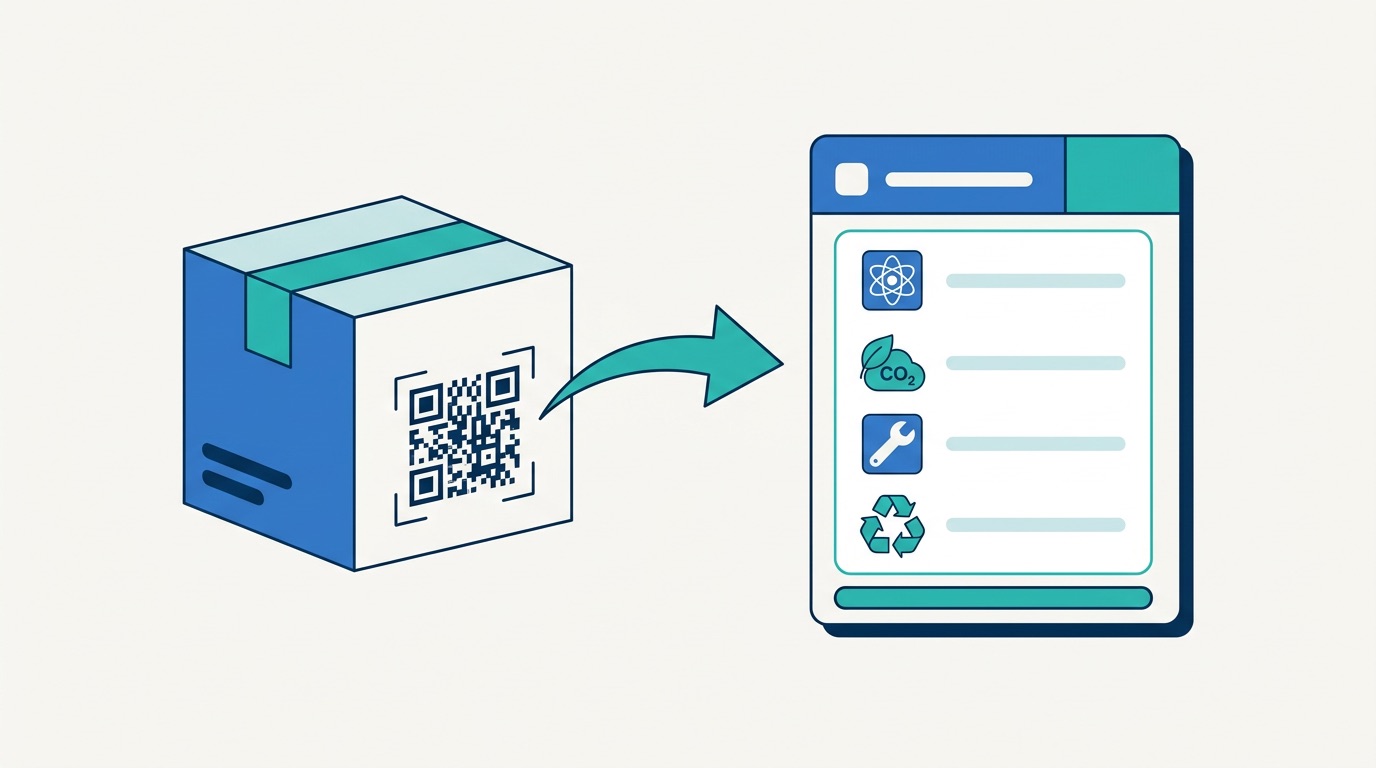
The Digital Product Passport is a central component of the EU's Ecodesign for Sustainable Products Regulation (ESPR), which entered into force on July 18, 2024. The DPP is a structured digital record — linked to a physical product via a machine-readable data carrier such as a QR code — that holds verified information about that product's lifecycle, environmental impact, and composition.
The goal is systemic: the EU wants to make every physical product traceable, circular, and environmentally accountable. By requiring manufacturers to encode product lifecycle data in a standardized, machine-readable format, the regulation enables consumers to make informed choices, repair businesses to access technical documentation, recyclers to process materials correctly, and regulators to verify compliance without physical inspection.
The DPP is not a standalone database — it is a distributed network of product records connected through a central EU registry. Each product receives a unique persistent identifier, and the data carrier (the QR code or equivalent) links that physical product to its digital record in real time. Under ESPR Article 10, the data carrier must comply with international standards, be physically present on the product or its packaging, and use open, interoperable formats without vendor lock-in.
For brands and manufacturers operating in the EU — or exporting to the EU — this is not optional. It is compliance infrastructure with hard deadlines and significant penalties for non-compliance, including restricted market access across all 27 EU member states.
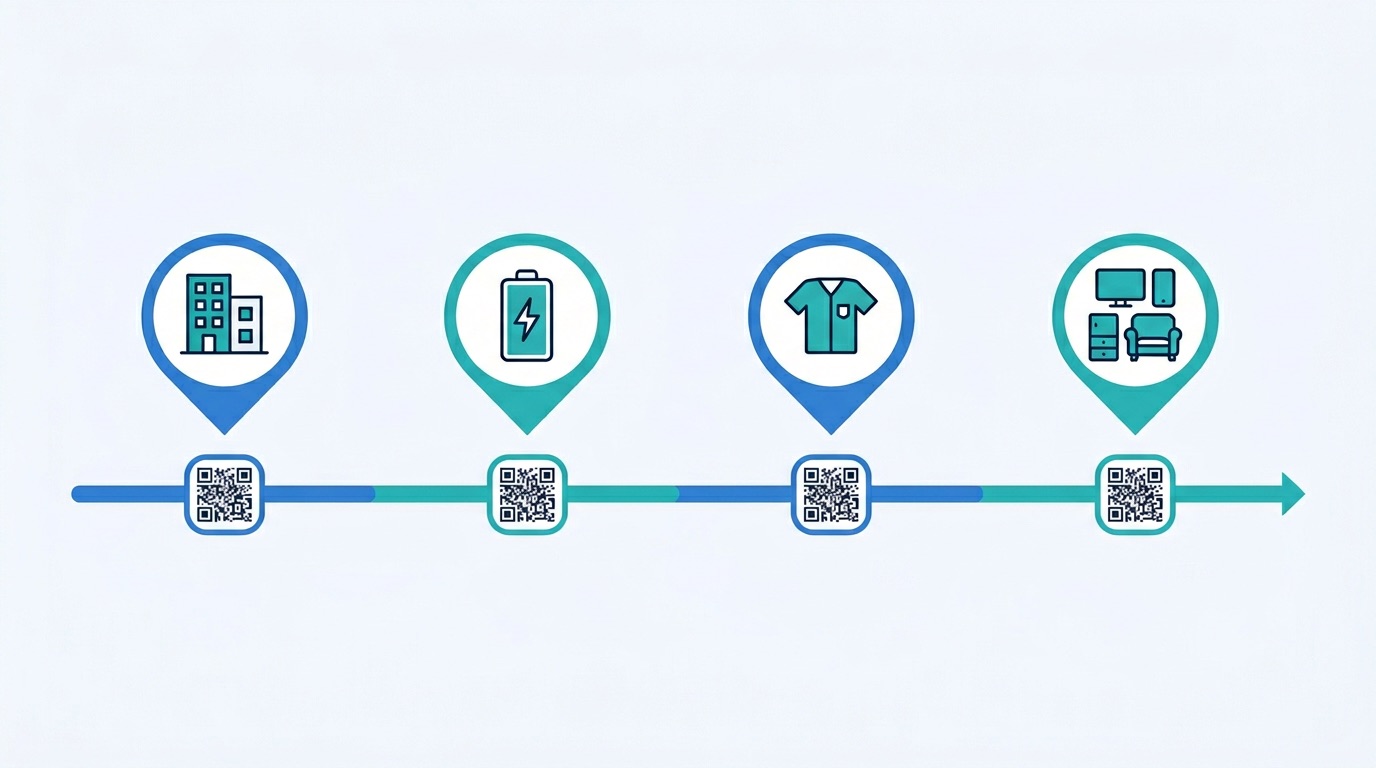
The DPP mandate rolls out in phases by product category. Understanding which deadlines apply to your industry is the starting point for compliance planning.
The EU's central DPP registry is set to become operational in 2026. Construction products — including building materials, insulation, and structural elements — begin their DPP compliance pathway. This year is also when companies across all affected sectors must shift from pilot programs to production-ready DPP systems, as the delegated acts under ESPR that specify detailed technical requirements are being finalized.
The first hard mandatory deadline: Battery passports are required for all EV batteries and industrial batteries over 2 kWh sold in the EU. This covers automotive manufacturers, industrial equipment makers, and energy storage companies. Battery passports must include: state of health, capacity, carbon footprint, material composition, sourcing data for critical raw materials (cobalt, lithium, nickel), and end-of-life recycling instructions. QR codes must be physically affixed to each battery unit.
The textiles and apparel sector faces DPP requirements covering: fiber composition, country of manufacture, care instructions, chemical use, resale and repair options, and environmental impact data. Every garment sold in the EU will need a DPP data carrier — making QR codes on clothing labels, hangtags, or garment tags the primary compliance mechanism for the fashion industry.
A broader wave of product categories follows: consumer electronics (smartphones, laptops, white goods) in 2029, furniture and mattresses in 2028, tyres in 2027, and steel and aluminium products rolling in through 2030. The regulation ultimately targets nearly all physical goods placed on the EU market — making DPP compliance a universal requirement for any brand with EU distribution.
The ESPR regulation does not prescribe a single data carrier technology — it mandates compliance with international standards. In practice, QR codes have emerged as the dominant DPP data carrier for several compelling reasons.
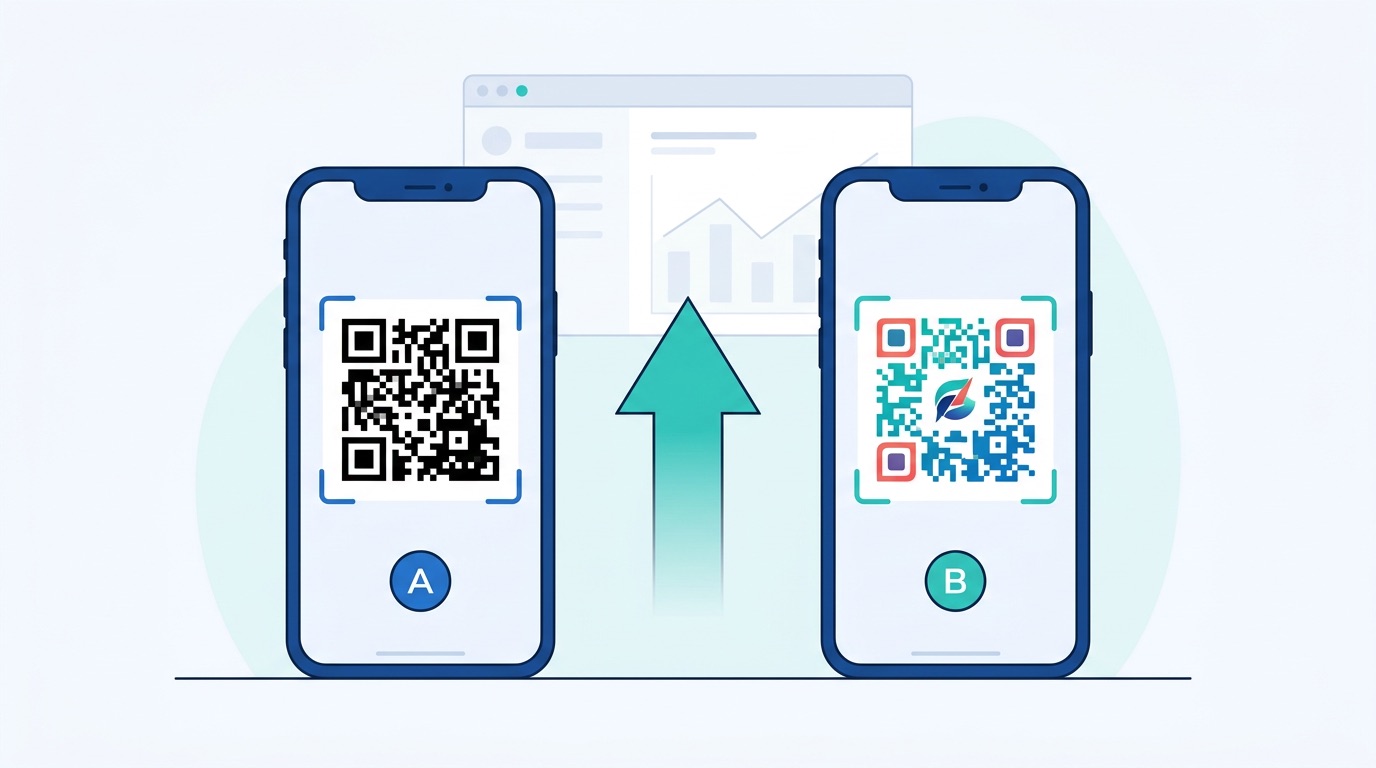
First, QR codes are the most universal and cost-effective option. Every modern smartphone camera can scan a QR code without a dedicated app, making them accessible to consumers, regulators, and supply chain partners without infrastructure investment. RFID and NFC offer additional capabilities for automated scanning environments (warehouses, logistics), but their per-unit cost is significantly higher — making QR codes the default for consumer products.
Second, QR codes align with GS1 global standards for product identification. The GS1 Digital Link standard — now adopted by GS1 globally as the successor to traditional barcodes — uses a URL-based QR code format that carries the Global Trade Item Number (GTIN) and links to rich product data. GS1 Digital Link QR codes are already interoperable with all major retail scanning infrastructure and are explicitly recognized under ESPR's interoperability requirements.
Third, dynamic QR codes allow the underlying data to be updated without reprinting labels. As the EU's delegated acts evolve and product data requirements change over time, brands using dynamic QR codes can update their DPP data records without recalling products or reprinting packaging — a critical operational advantage given the multi-year rollout of the regulation.
For most businesses, the practical DPP implementation path is: generate a URL QR code linking to a compliant DPP data record for each product, affix it to the product or packaging, and maintain the linked data record in a registry-connected system as requirements evolve.
The specific data fields required in a DPP vary by product category and are defined in delegated acts published under ESPR. However, the regulation establishes a common data framework that applies across all categories. At minimum, a compliant DPP must include:
Data must be accurate, up-to-date, and accessible without authentication barriers for the basic consumer-facing information. More detailed technical data (repair manuals, component specifications) can be access-controlled for professional stakeholders. For a deeper look at how QR codes are being used to deliver supply chain transparency, see QR Codes for Sustainable Marketing and QR Codes and Conscious Consumers.
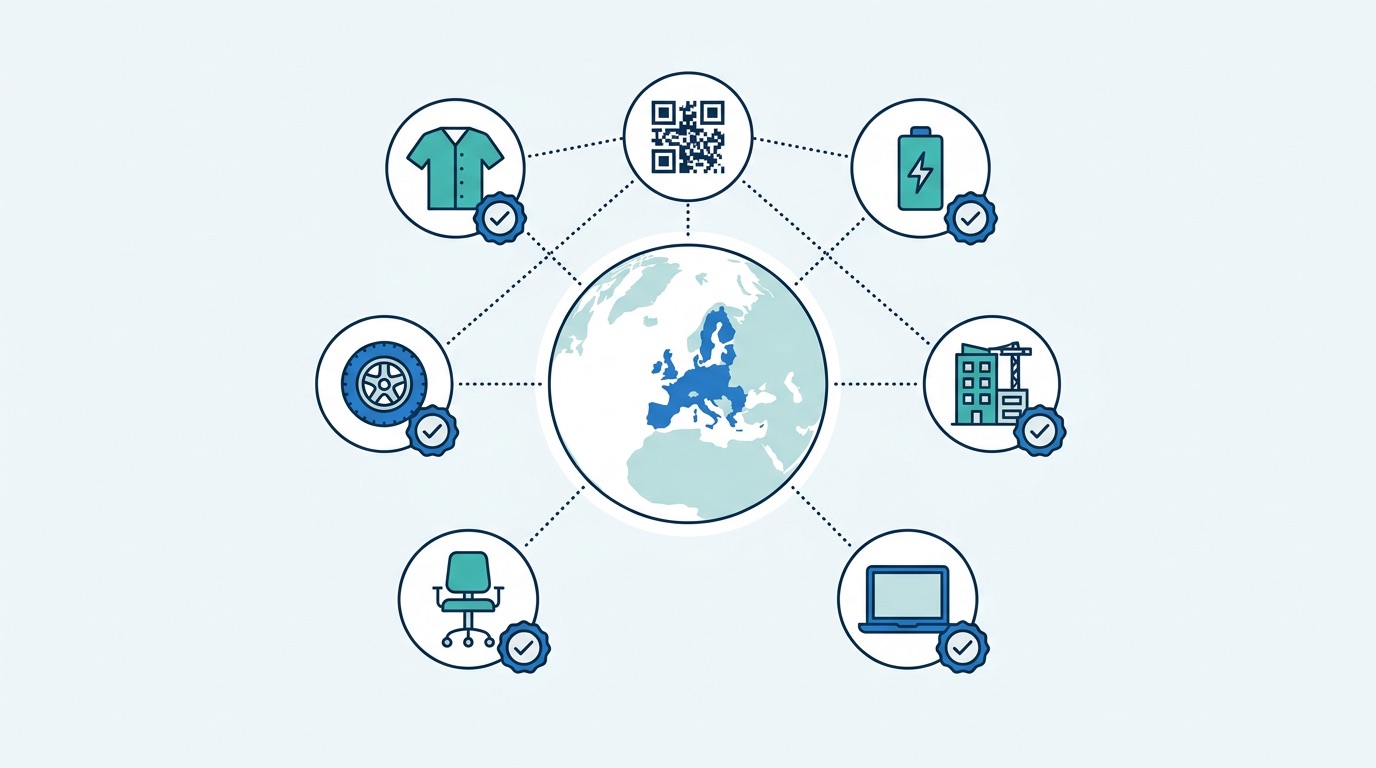
The EU DPP applies to any company placing physical products on the EU market — regardless of where those products are manufactured. This is a critical point: a US, Asian, or UK-based brand that exports to EU countries must comply with DPP requirements for those products, even if it has no EU manufacturing presence.
The regulation applies to manufacturers, authorised representatives in the EU, importers, and in some cases distributors. The compliance obligation sits primarily with the entity that places the product on the EU market — typically the brand owner or importer. Key affected sectors and their approximate timelines:
Only 18% of global manufacturers are currently using digital product passports, though 63% expect wider adoption within three years, according to Loftware's 2025 survey. The preparedness gap is enormous — which means companies that build DPP-ready QR code infrastructure now will have a significant first-mover advantage when mandatory deadlines arrive.
Not all QR codes are equal for DPP compliance purposes. The choice between GS1 Digital Link and proprietary QR codes has significant long-term implications.
GS1 Digital Link is the globally standardized URL-based QR code format that embeds a product's GTIN (Global Trade Item Number) and links to structured product data. It is already recognized by all major EU retailers and scanning infrastructure, satisfies ESPR interoperability requirements, and is the format that GS1 Europe explicitly recommends for DPP compliance.
A GS1 Digital Link URL looks like: https://id.gs1.org/01/05060123456781 — where 01 is the GS1 Application Identifier for GTIN, followed by the 14-digit product code. This URL resolves to a structured DPP data record that can be hosted by the brand, a third-party registry, or the EU's central registry when it launches.
Brands can use proprietary QR codes (including dynamic URL codes from platforms like Supercode) for DPP implementation, provided the underlying URL links to a compliant, standards-based data record. The QR code is the carrier; the compliance is in the data it links to. A Supercode dynamic URL QR code pointing to a GS1-structured product data endpoint can be fully DPP compliant.
The key risks with proprietary codes are: vendor lock-in (if the QR platform goes offline, all product links break) and limited interoperability with automated B2B scanning systems that expect GS1-format identifiers. For consumer-facing DPP compliance, proprietary QR codes with dynamic URLs are a practical solution. For industrial and supply chain DPP integration, GS1 Digital Link is the superior choice.
The EU DPP regulation will evolve. Delegated acts will add new data requirements over time. Carbon footprint methodologies will be updated. Regulatory thresholds for hazardous substances will change. Any DPP implementation strategy must account for the fact that the underlying data requirements are a moving target.
This is where dynamic QR codes deliver critical operational value. With a dynamic QR code:
For enterprises managing large product portfolios, the enterprise QR code strategy guides illustrate how centralized dynamic QR management enables compliance across complex, multi-SKU product lines. See also the QR Code Trends 2026 post for how the EU DPP is reshaping QR code adoption across industries.
The practical DPP implementation looks different across product categories. Here are the key considerations for the sectors facing the earliest deadlines.
For the fashion industry, the DPP represents a fundamental change to how garment labelling works. Every item must carry a data carrier — with QR codes on clothing labels or hangtags being the dominant approach. The DPP data for textiles must include: fiber composition (% of each fiber type), country of origin, care instructions, chemical substance declarations, recycling instructions, and the nearest take-back scheme location.
For fast fashion brands with high SKU turnover, the DPP requires a data management infrastructure that can generate unique, linked QR codes for each product style and colorway, update linked data when formulations or suppliers change, and retire records for discontinued lines.
The luxury sector faces a double obligation: DPP compliance AND brand authenticity. Dynamic QR codes on luxury products serve both purposes — they link to the DPP data record for regulatory compliance and to authentication certificates that prove provenance. Dynamic codes allow luxury brands to include both data streams in a single physical carrier, reducing label complexity while satisfying compliance requirements.
Battery DPPs are the most data-intensive requirement. Each battery passport must include: electrochemical performance, state of health, charging cycles, capacity, critical mineral sourcing data (with mine-level traceability for cobalt and lithium), carbon footprint per kWh, and end-of-life handling instructions. For electronics, upcoming requirements will cover product durability scores, software update lifecycles, and spare parts availability windows — all of which must be accessible via the product's data carrier.
Separate EU packaging regulations (Packaging and Packaging Waste Regulation, PPWR) will require QR codes on all packaging to carry recycling and material composition data by 2030. For brands affected by both ESPR (product DPP) and PPWR (packaging DPP), a unified QR code strategy that handles both compliance streams is more efficient than two separate implementations. See product packaging QR codes and food packaging QR codes for placement guidance.
Given that 82% of companies are currently unprepared and mandatory deadlines begin in 2027, the time to start is now. Here is a practical preparation framework.
Identify which products fall under which DPP categories and their applicable deadlines. Prioritize the earliest-deadline categories (batteries, construction by 2026–2027; textiles by mid-2027). Create a master product list with current data availability for each required DPP field — this data gap audit will reveal where the hardest work lies.
The hardest part of DPP compliance is not the QR code — it is the upstream data collection. Material composition data must come from suppliers. Carbon footprint data requires life cycle assessment methodology or certified third-party data. Chemical substance declarations require verified supplier documentation. Begin engaging your key suppliers now to understand data availability and establish data exchange workflows.
Decide whether to host DPP data records internally (requires technical infrastructure) or use a third-party DPP platform. Ensure your chosen approach will be interoperable with the EU's central registry when it launches. Select your data carrier format — GS1 Digital Link for supply chain and B2B scenarios, dynamic QR codes for consumer-facing DPP implementation.
Use Supercode's QR code platform to create dynamic URL QR codes for each product SKU, linking to your DPP data records. For large catalogs, use bulk QR code generation to create hundreds of unique codes via CSV import. Integrate QR code generation into your product launch workflow so every new SKU automatically receives a DPP-linked code. See pricing plans for enterprise bulk generation options.
DPP compliance is not a one-time event. Track scan analytics to confirm consumers and regulators can access DPP records. Update linked data records as formulations, suppliers, or requirements change. Monitor EU delegated acts for new data field requirements in your product category. Use Supercode's dynamic code management to push updates to existing deployed codes without reprinting.
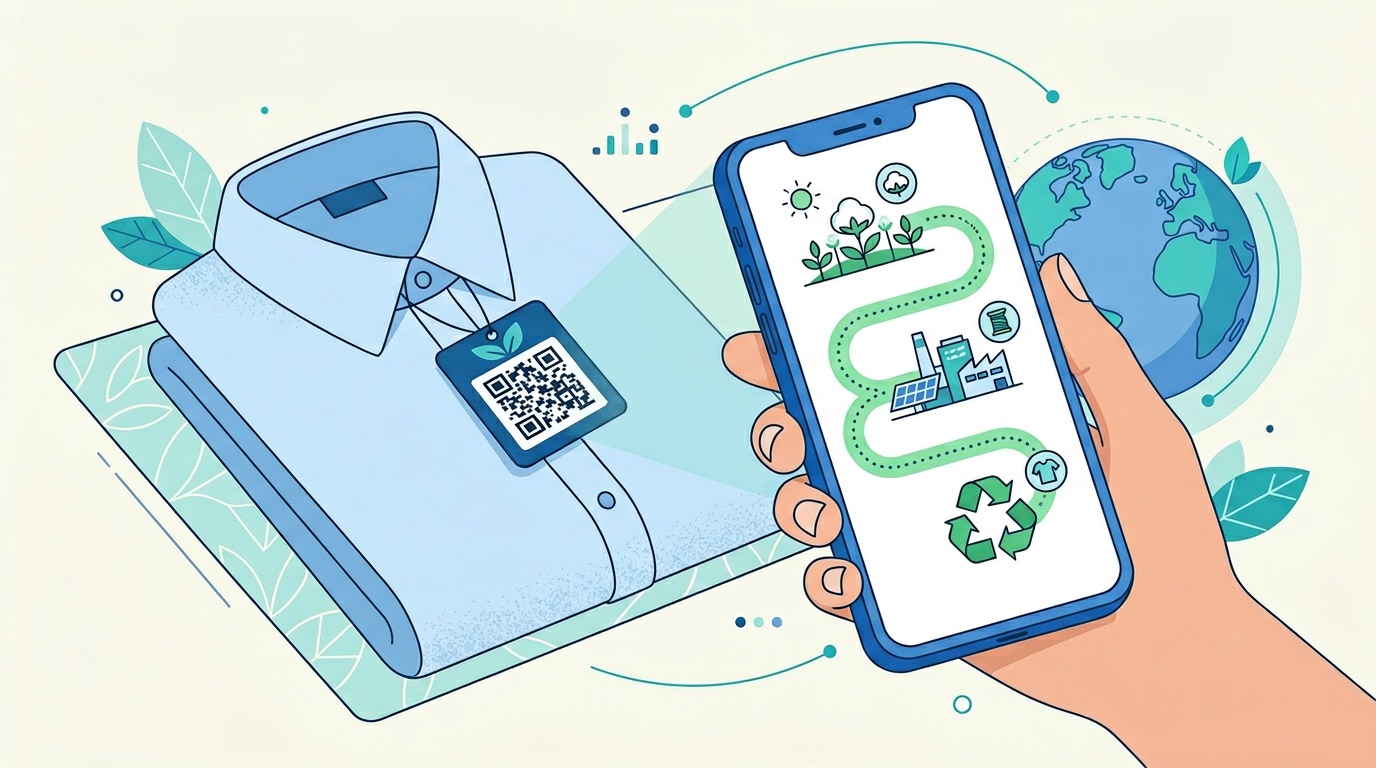
Forward-thinking brands are recognizing the EU DPP not just as a compliance burden but as a marketing asset. A QR code that reveals a product's full sustainability story — recycled content, low-carbon manufacturing, ethical sourcing, repair support — is also a powerful brand transparency tool that resonates with eco-aware consumers.
80% of consumers are more likely to buy from brands that use QR codes to provide transparency, according to market research. The DPP forces that transparency — but brands that communicate it compellingly rather than treating it as a checkbox exercise will convert compliance into competitive advantage.
Consider: a fashion brand that uses its DPP QR code to tell the story of each garment's supply chain — the farm where cotton was grown, the factory where it was woven, the carbon offset applied to shipping — is using the DPP as storytelling infrastructure. A consumer electronics brand that links its DPP to a repair guide and spare parts store is using compliance as an extended warranty differentiator.
The brands winning on sustainability in 2026 and beyond are those that treat the QR code on their product not as a regulatory sticker but as a direct channel to the consumer — integrated into their broader QR code marketing strategy. For industry-specific QR code strategies, see QR Code Statistics 2026 and the Supercode solutions overview.
The EU Digital Product Passport is a digital record linked to a physical product via a machine-readable data carrier (typically a QR code) that contains verified information about the product's lifecycle, material composition, carbon footprint, repairability, and end-of-life handling. It is mandated by the EU's Ecodesign for Sustainable Products Regulation (ESPR), which entered into force on July 18, 2024.
Deadlines vary by product category: construction products begin implementation in 2026; EV and industrial battery passports are mandatory from February 18, 2027; textiles and apparel face requirements from mid-2027; furniture and mattresses from 2028; consumer electronics from 2029. Additional categories including steel, aluminium, and packaging follow through 2030.
Yes. The regulation applies to any company placing products on the EU market — regardless of where the manufacturer or brand owner is based. If you manufacture in Asia, the US, or the UK and sell products in EU countries, those products must have compliant DPPs when the applicable deadlines arrive.
Yes. QR codes are the primary data carrier for DPP compliance, particularly for consumer-facing products. The ESPR regulation requires data carriers to comply with international standards and use open, interoperable formats. GS1 Digital Link QR codes are explicitly recommended for DPP compliance. Dynamic URL QR codes pointing to compliant DPP data records also satisfy the requirements.
A static QR code encodes a fixed URL that cannot be changed after printing. A dynamic QR code redirects through a tracking server, allowing the destination to be updated at any time. For DPP compliance, dynamic QR codes are strongly recommended because they allow brands to update linked product data records as regulatory requirements evolve — without recalling products or reprinting labels.
Non-compliance consequences include: market access restrictions (products without compliant DPPs cannot legally be placed on the EU market), financial penalties (set by individual member states, likely significant given the breadth of the regulation), and reputational damage from regulatory scrutiny. For high-volume importers, market access restriction across 27 EU member states represents a substantial commercial risk.
Start with a product portfolio audit to identify which categories and deadlines apply to your business. Map your supply chain to understand what data is available and where gaps exist. Choose a data architecture (internal hosting vs. third-party DPP platform) and select a QR code solution that supports dynamic URL updates and bulk generation. Generate DPP-linked QR codes for your products and integrate the process into your product launch workflow.
The EU Digital Product Passport is the most significant product information regulation in decades — and the 2027 deadlines are closer than they appear. With 82% of companies currently unprepared and the data collection groundwork taking 12–18 months to establish, the brands that start building DPP-compliant QR code infrastructure in 2026 will meet their deadlines with confidence. Those that wait will face costly emergency implementations under regulatory pressure.
Supercode provides the dynamic QR code platform and bulk generation tools that make DPP-scale QR deployment practical — from single products to multi-thousand SKU catalogs. Start building your DPP QR infrastructure with Supercode — try free or view enterprise pricing plans.
For related compliance and sustainability strategies, see QR Code Trends 2026, QR Codes for Sustainable Marketing, and the Enterprise QR Code Strategy Guide.