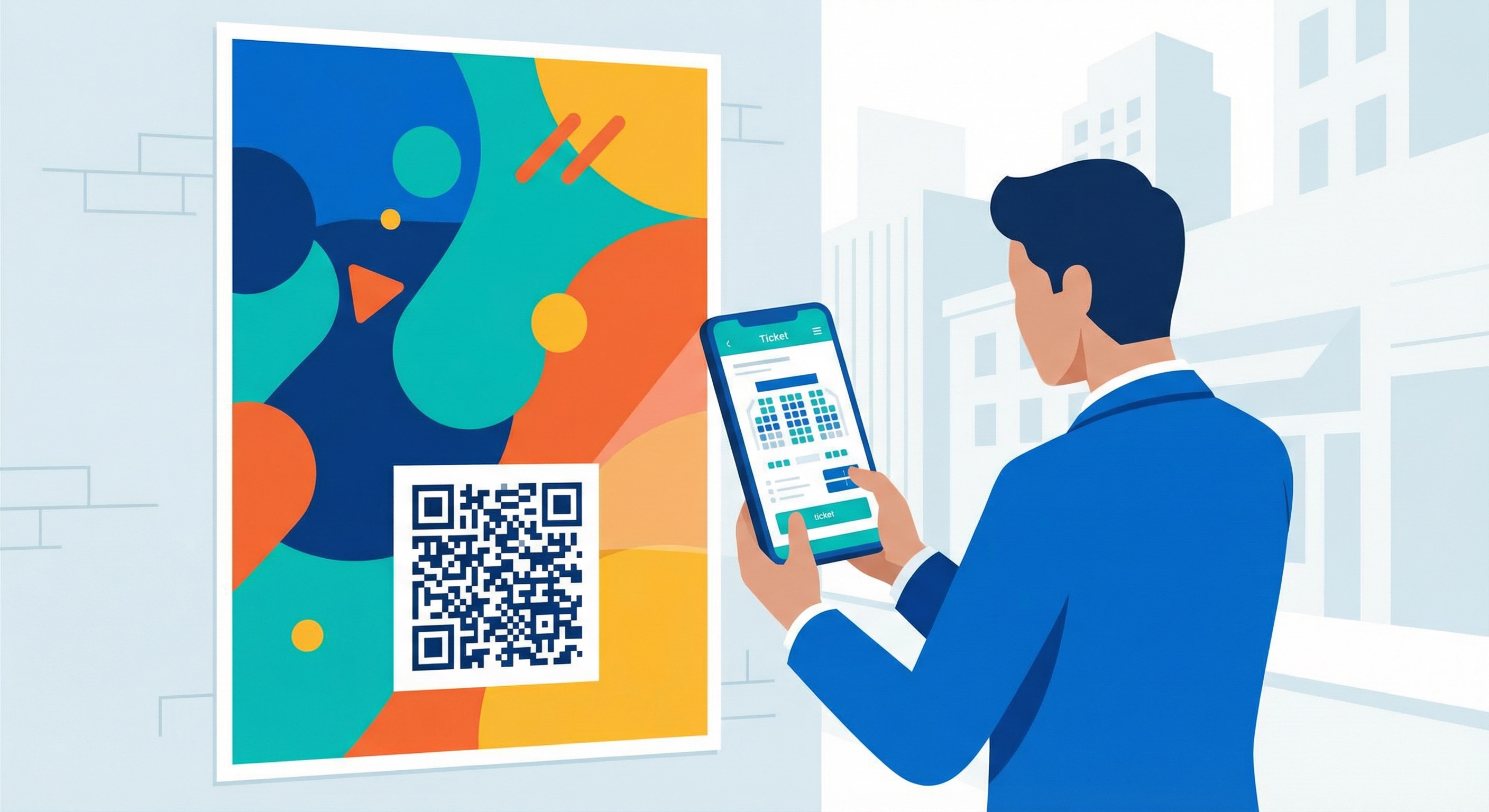

Print advertising has a new superpower. Combining outdoor and indoor posters with QR codes can boost ad awareness by up to 200% — transforming a static image into an interactive, measurable marketing channel. 40% of marketers now deploy QR codes in print advertising, and the global QR code scan rate has grown by 433% in recent years, with 59% of consumers scanning daily (Bitly State of QR Codes 2025; Rytinco QR Statistics 2025).
For brands running poster campaigns — whether for events, retail promotions, entertainment, tourism, or product launches — QR codes bridge the gap between physical visibility and digital conversion. This guide covers every aspect of using QR codes on posters: the key benefits, real-world applications across industries, the latest statistics, and a step-by-step guide to creating and tracking poster QR codes with Supercode.
A poster without a QR code delivers an impression — a poster with one delivers a conversion opportunity. QR-initiated customer journeys achieve a 37% average click-through rate, compared to 2-5% for standard digital display advertising (Rytinco, 2025). That means every poster in your campaign becomes a trackable asset, not just a branding exercise. With QR code analytics, you can measure exactly how many scans each location generated, at what time of day, and on which device — data that traditional print never provides. Learn how to connect your poster campaigns to your full analytics stack in the complete QR code tracking guide.
With a dynamic QR code, the printed code on your poster stays the same while the destination URL can change at any time. Launch a poster today pointing to a pre-sale page, update it to a booking page on opening day, and redirect it to a review platform post-event — all without touching the physical poster. This is particularly valuable for long-run poster placements like building hoardings, transit advertising, and window signage. Businesses using dynamic QR codes report 60% higher engagement rates than those using static codes, and cost savings from eliminating reprints can reach significant sums annually (Rytinco, 2025).
Posters excel at capturing attention in high-footfall locations. A QR code turns that attention into action — directing passers-by to a website, an app store, a social media profile, a booking page, or an exclusive offer. 94% of marketers consider QR codes effective for driving customer engagement, and 79% of smartphone users have scanned a QR code in the past year (Rytinco, 2025). For retail brands, this means a window poster becomes a 24/7 salesperson. For event organisers, a venue poster becomes a ticket purchase gateway.
When a poster QR code links to shareable content — a playlist, a contest, a video, a social media challenge — every scan has the potential to generate organic amplification. Musicians and artists use poster QR codes to drive streaming follows and playlist additions, generating continued engagement long after the gig has ended. Link your poster code to a social media QR code destination and every scan can become a new follower.
Using bulk QR codes, brands can generate unique codes for different poster locations, enabling location-level performance tracking and A/B testing across districts, cities, or venues. For trade show and exhibition marketers running campaigns across multiple halls or venues, this granularity is invaluable for optimising future placements. Explore QR code marketing strategy to see how bulk poster campaigns are structured.
A poster has finite space. A QR code is unlimited. Link your poster code to a full product catalogue, a video tour, an audio guide, a multilingual landing page, or a competition entry form. For tourism campaigns, a destination poster can link to an interactive map, booking options, and visitor reviews. For restaurants, a promotional poster can link directly to the digital menu or reservation system. The poster creates curiosity — the QR code satisfies it.
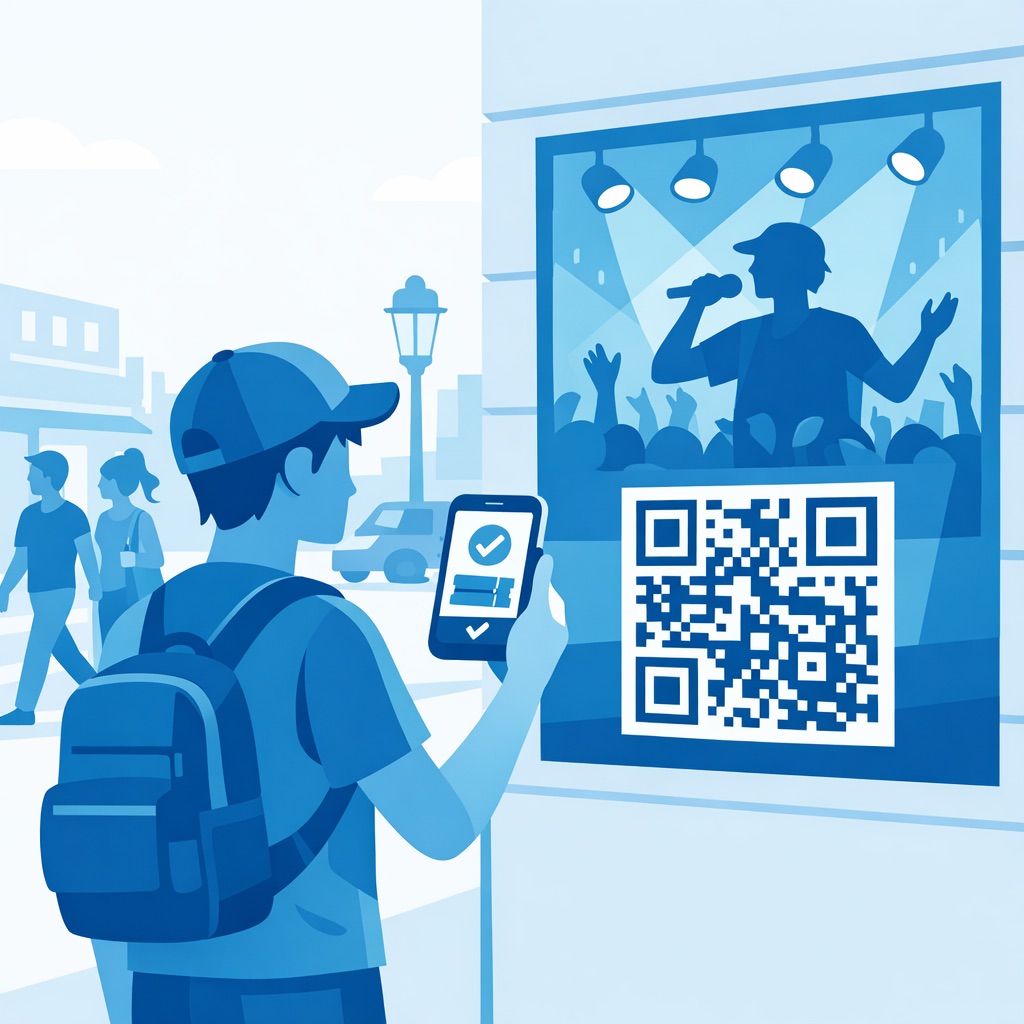
Event posters are one of the most natural homes for a QR code. A code placed prominently on a concert, festival, or exhibition poster links directly to a ticket purchase page, reducing the friction between discovery and conversion. Event organisers can use dynamic codes to redirect traffic as the campaign evolves — from an announcement page to a booking portal to a post-event highlights reel. Major brands like Red Bull and global music festivals regularly integrate QR codes into their poster campaigns to drive registration, app downloads, and social follows simultaneously.
Retail brands place QR codes on window posters and in-store promotional displays to drive shoppers from physical footfall to digital experiences: product pages, loyalty programme sign-ups, wishlist features, and exclusive offers. A QR code on a window poster transforms a closed store into a 24/7 sales channel — shoppers browsing after hours can scan and purchase from the window. Combine with feedback QR codes on in-store posters to collect post-visit reviews and satisfaction scores.
Restaurants, bars, and hospitality venues use printed posters and table displays to promote seasonal menus, happy hour offers, and special events. A QR code on a poster near the entrance links to the digital menu, removing the wait for a physical copy. Hospitality brands also use lobby and lift posters with QR codes to promote in-hotel services: spa bookings, restaurant reservations, and local tours. The poster creates the moment; the QR code enables immediate action.
Street poster campaigns have long been a cornerstone of music and entertainment marketing — and QR codes amplify their power significantly. Musicians and artists use poster QR codes to drive streaming platform follows, album pre-saves, tour ticket purchases, and social media engagement in a single scan. Film studios link poster codes to trailers, cast interviews, and booking pages. For limited-run art exhibitions, a poster code can link to a preview, ticketing, and a map — all with one scan.
Tourism boards and destination marketers use poster campaigns in transport hubs, hotels, and visitor centres to connect potential visitors with rich digital content: virtual tours, booking platforms, itinerary guides, and real-time local information. A well-placed QR code on a tourism poster at an airport or railway station — positioned at the exact moment a traveller is planning their stay — is one of the highest-converting placements available. Link to a photo gallery QR code for visual inspiration or a PDF QR code for a downloadable travel guide.
Governments, charities, and public sector organisations use poster campaigns to reach wide audiences — and QR codes make those campaigns interactive. A health campaign poster with a QR code can link to a symptom checker, an appointment booking page, or a multilingual information resource. Community organisations use QR codes on notice boards to link to event listings, volunteer sign-ups, and local resource directories. The code makes bureaucratic information accessible in a single tap.
Out-of-home advertisers are rapidly adopting QR codes on large-format posters, transit advertising, and billboards. Campaigns combining OOH placements with QR codes have demonstrated the ability to boost overall ad awareness by up to 200% (Scanova, 2026), because the QR code creates a digital layer that reinforces the physical message. For transit and billboard campaigns, dynamic codes enable the campaign message to be updated across all placements simultaneously without a reprint — a significant advantage for time-sensitive promotions.
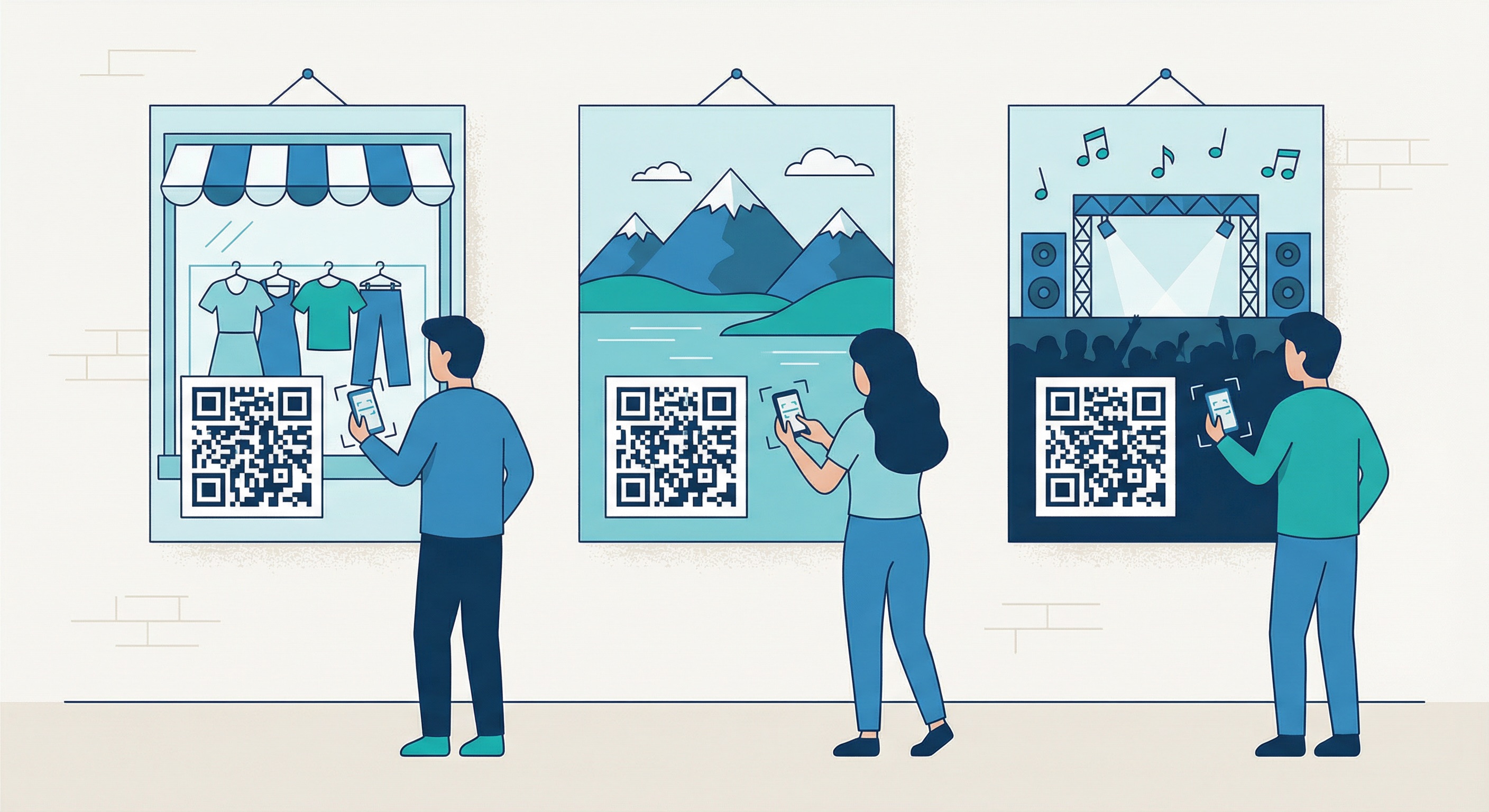
The numbers confirm what marketers already sense: print advertising with QR codes is delivering measurable digital ROI at scale.
For the full picture, explore the QR code statistics 2026 report, which covers adoption rates, industry breakdowns, and consumer behaviour data.
Creating a poster QR code that performs requires more than generating a code — it requires the right type, design, and setup. Here is the step-by-step process with Supercode.
For posters, dynamic QR codes are non-negotiable. They allow you to update the destination after printing, track scan analytics, and run A/B tests across placements — none of which is possible with a static code. A static code printed on 500 posters is locked forever. A dynamic code gives you full control throughout the campaign. See the full comparison in our dynamic vs. static QR codes guide.
Sizing is critical for poster QR codes. Use the 10:1 rule: scanning distance should be no more than 10 times the width of the QR code. Practical guidelines:
For full sizing tables and DPI recommendations, see the QR code printing guide.
Supercode's design tools let you apply your brand colours, add your logo, and choose from multiple pattern and corner styles. Branded QR codes on posters achieve 25–40% higher scan rates than plain black-and-white codes. Key design rules for poster QR codes: maintain at least 4:1 contrast ratio between modules and background; do not place the code on a patterned or photographic background; always include a quiet zone of 4 modules on all sides. See the QR code design guide for full colour and logo rules.
Research shows that 55% of marketers report consumers don't always know why to scan a QR code (Bitly, 2025). The solution is a clear, action-oriented CTA printed directly next to the code: "Scan for tickets", "Scan to enter the draw", "Scan for the full menu", "Scan to follow us". Keep it short, specific, and benefit-led. The CTA is often more important than the code design itself.
Once your posters are live, monitor scan performance in the Supercode dashboard. For multi-location campaigns, create one dynamic code per location — or use bulk QR codes with location-specific UTM parameters — to compare performance across sites. Key metrics to track: scan volume by location, time-of-day distribution, device type, and conversion rate from scan to desired action. Full guidance in the QR code tracking guide.

Place the QR code at 120–150cm from the ground (eye level for most adults), ideally in the lower-right third of the poster where the eye naturally lands after reading the headline. For transit posters at seated height (bus/train), position lower to align with seated eye level. Never place a QR code in the top corner or at floor level — these placements have low scan rates because they require awkward camera angles. Consult the printing guide for placement diagrams by poster format.
The most common poster QR code failure is placing the code over a photographic or patterned background. Smartphone cameras need clear contrast between the dark modules and a light background to decode reliably. If your poster has a dark or busy background, place the QR code in a white or light-coloured box with adequate padding. This is also where the quiet zone becomes essential — it is the visual separation that tells the camera where the code begins and ends.
Every poster scan happens on a smartphone. If the destination landing page is not mobile-first — with fast load times, readable text, and tap-friendly buttons — you will lose the conversion even after winning the scan. Test your landing page on multiple devices and screen sizes before the poster goes live. Use dynamic QR codes so you can swap a slow-loading page for a better one post-print if needed.
If you are placing posters in multiple locations — different shops, venues, or cities — use a unique dynamic code per location. This enables you to compare performance across sites and identify which locations drive the most engagement. Combined with UTM parameter tracking, you can trace each scan right through to a purchase or sign-up. Supercode's bulk QR code generator makes it easy to create and export location-specific codes at scale.
Always scan a proof print before approving the full run. Check the code in low light (some venues have dim lighting), at varying distances, and at angles rather than straight-on. If a code does not scan reliably under realistic conditions, increase the size, improve the contrast, or raise the error correction to Level H. Refer to 10 QR code mistakes to avoid for a full pre-print checklist. A non-scanning code on 1,000 printed posters is a wasted campaign.
The poster goes up before the digital experience is ready — this is one of the most common QR poster mistakes. Always ensure the destination URL is live and fully functional before posters are printed or installed. For campaigns with staged launches (pre-sale → on-sale → last chance), plan the dynamic code redirect schedule in advance and set calendar reminders to update each redirect at the correct time. Use the QR code marketing strategy guide to build a complete campaign timeline.
Use the 10:1 rule: the QR code width should be at least one-tenth of the intended scanning distance. For a standard A3 indoor poster scanned from 1 metre away, a 5–10cm QR code is sufficient. For a large-format outdoor poster scanned from 3 metres, the code should be at least 30cm. The QR code printing guide has a full sizing table for every poster format.
Yes — with a dynamic QR code. Dynamic codes redirect through a short URL that you control, meaning the printed code stays the same while the destination can change at any time. This is essential for posters with long display periods or campaigns that evolve over time. Static QR codes are permanently fixed and cannot be changed after printing. See our dynamic vs. static QR code guide for a full explanation.
Position QR codes at eye level (approximately 120–150cm from the ground) and in the lower-right or lower-centre area of the poster — after the main headline and visual have captured attention. Avoid placing the code on textured, patterned, or dark backgrounds. Always include a quiet zone and a clear CTA directly next to the code explaining what the viewer will get by scanning.
No. Any smartphone running iOS 11+ or modern Android (2018 onward) can scan QR codes directly through the native camera app — no third-party app required. This frictionless experience is one reason why 59% of consumers scan QR codes daily. Simply open the camera, point it at the code, and tap the notification that appears.
Yes, with location-specific dynamic QR codes. By assigning a unique code to each poster location, you can compare scan volume, time-of-day patterns, and device types across all sites from the Supercode analytics dashboard. Add UTM parameters to each destination URL to carry location data through to your website analytics and conversion tracking. Full instructions in the QR code tracking guide.
It depends on your campaign goal. Common destinations include: event ticket purchase pages, product pages with exclusive poster-viewer offers, social media profiles or multi-link hubs, competition entry forms, video trailers, digital menus, booking systems, and app download pages. The key is to match the destination to the promise of the CTA printed next to the code — if the CTA says "scan for your exclusive discount", the landing page must deliver that discount immediately, with no navigation required.
Whether you're running a small-batch event poster or a national OOH advertising campaign, Supercode gives you the tools to create, design, track, and optimise poster QR codes at any scale. Dynamic codes, branded design, bulk generation, and real-time analytics — everything you need to make your poster campaign measurable and adaptable in 2026.
Head to our FAQs section or reach out to us directly on info@supercode.com
Sign up for free

