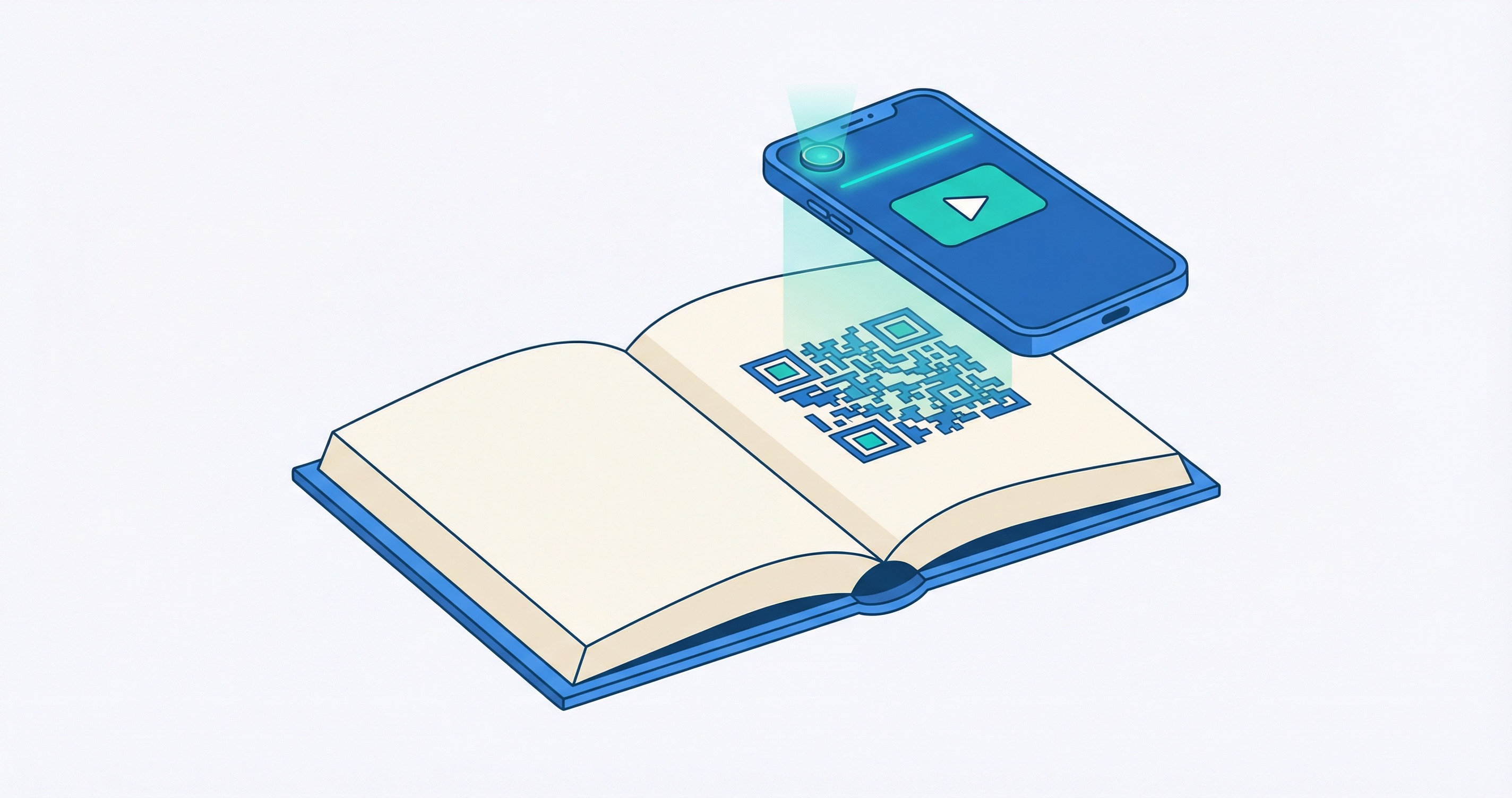

The publishing and media industry is undergoing a fundamental transformation. In 2025, 2.2 billion people worldwide actively use QR codes — representing 29% of all smartphone users globally. For publishers, authors, educators, and media professionals, this shift creates a powerful opportunity: the ability to seamlessly bridge the gap between physical printed materials and the limitless digital content that readers increasingly expect. Whether you are publishing textbooks, magazines, newspapers, or novels, QR codes are quickly becoming an essential tool for delivering richer experiences, driving reader engagement, and measuring the success of print campaigns in 2026 and beyond. In this guide, we cover the key benefits, real-world applications, latest statistics, and best practices for using QR codes in publishing and media.

Adding QR codes to your publishing workflow offers a range of competitive advantages — from deeper reader engagement to fraud prevention.
Physical publications have an inherent limitation: they are static. A QR code printed in a book, magazine, or newspaper instantly removes that limitation by connecting readers to multimedia content, interactive tools, extended articles, or supporting data — all from a single scan. This is especially valuable for books that benefit from supplementary audio, video demonstrations, or updated editions. Publishers using URL QR codes can even update the destination link after print, ensuring readers always reach the most current content without reprinting a single page.
Modern readers expect more than static text. QR codes embedded in magazines and newspapers can link to video interviews, podcasts, AR experiences, and interactive data visualizations that are impossible to include on a printed page. According to a 2025 Bitly survey, 37% of marketers now use QR codes to link to video demonstrations, while 51% use them for promotional content. Readers consistently reward publications that offer these extended experiences with longer dwell times and stronger brand loyalty.
QR codes make it effortless to convert readers into buyers. A QR code on a magazine cover linking directly to a subscription offer, or a QR code in a book linking to a related product page, creates instant mobile-commerce opportunities. South African publisher Associated Media Publishing (AMP) demonstrated this perfectly: after running QR code campaigns in five best-selling magazines, page views in their online shops grew from 47,000 to 84,441 and products available for sale grew from 1,500 to 3,174 within months. For broader e-commerce applications, explore how QR codes in retail are powering similar purchase journeys.
Unlike print-only campaigns, QR codes give publishers measurable data. Every scan is recorded — including location, time, device type, and scan count — giving editorial and marketing teams real-time insight into which articles, ads, or pages generate the most reader action. Use Supercode's QR code tracking dashboard to monitor performance, identify what resonates with your audience, and optimize future editions accordingly. This transforms print from a one-way broadcast into a measurable, data-driven channel.
Today's readers want a relationship with the authors and editors they follow. A social media QR code placed inside a novel, on an article byline, or on a magazine cover page can send readers directly to an author's Instagram, LinkedIn, or YouTube channel. Authors can use this connection to announce new works, share behind-the-scenes content, respond to reader questions, and grow their audiences between publication cycles. This is particularly valuable for novelists, journalists, and non-fiction writers building personal brands alongside their published work. See how musicians and artists use the same approach to engage their audiences.
Digital piracy continues to cost the publishing industry billions annually. According to MUSO's 2024 Publishing Piracy Report, there were 66.4 billion visits to publishing piracy websites in 2024 — a 4.3% increase year-on-year, making publishing the only major content sector where piracy is still growing. Major educational publisher McGraw Hill has responded by embedding unique certification QR codes in their textbooks, allowing students and educators to instantly verify that a copy is authentic and not counterfeit. This approach protects revenue while simultaneously adding value for legitimate buyers.

From primary school textbooks to industry trade magazines, QR codes are finding practical applications across every corner of the publishing world.
Educational publishers are among the most enthusiastic adopters of QR codes. Research cited by QR Code UK shows that 45% of schools and universities in the United States have now adopted QR codes for educational purposes. Textbook QR codes can link to lecture videos, pronunciation audio for language learning, lab experiment demonstrations, and supplementary reading lists. Color-coding QR codes by subject or chapter — for example, blue for videos, green for quizzes — helps students quickly identify what content type they are about to access. For more, see our dedicated page on QR codes for education.
Print news has embraced QR codes as a way to offer the immersive digital experience that online media provides, without abandoning the trusted printed format. Newspapers can place QR codes beside articles to link to video reports, extended interviews, interactive infographics, and reader comment sections. Magazines can embed QR codes in advertisements to create shoppable pages, or in editorial content to let readers explore related stories on the publication's website. Our dedicated pages on QR codes in magazines and newspapers and QR codes on posters explore these print applications in depth.
The publishing industry has learned from Hollywood: trailers drive excitement and pre-orders. Publishers now produce video book trailers and promote them via QR codes printed inside previous books, on bookshelf talkers, on coffee cup sleeves in bookstores, and on promotional flyers and brochures. Children's books in particular benefit from this approach — animated trailers dramatically increase a child's excitement and desire to read. QR codes linking to trailers can be placed on back covers, inside dust jackets, or on dedicated shelf-edge displays in bookstores.
Newspapers and magazines can use QR codes to build community around their content. Placing a QR code next to a feature article that links to a discussion board or comments section encourages readers to engage not just with the text, but with each other. Ratings, polls, and reader feedback forms linked via QR codes create a feedback loop between publishers and their audience that was previously possible only in the digital space. Use a feedback QR code to capture reader reactions and editorial opinions directly from a printed page.
Publishers producing teacher resources — lesson plan books, curriculum guides, and professional development materials — can use QR codes to link teachers to editable templates, printable worksheets, slide deck downloads, and demonstration videos. A PDF QR code is ideal for distributing downloadable lesson materials that teachers can print and adapt. This saves significant time and dramatically increases the practical value of what would otherwise be a static print resource.
Before committing to a full audiobook or novel, readers often want a sample. QR codes printed on bookstore shelf displays, coffee cup sleeves, or inside related books can link directly to a 5-10 minute audio preview hosted on the publisher's website or on streaming platforms. URL QR codes are well-suited for this application. Even free ebook samples can be distributed via a QR code that unlocks a chapter PDF, as several children's publishers have done successfully to grow their reader base.
Publishers offering digital-physical bundles — where a physical book purchase unlocks a digital copy — can use QR codes to deliver that access seamlessly. A unique plain text QR code or URL code printed inside the book can deliver a redemption link valid only for that specific copy. For subscription-based publications like trade magazines, QR codes can prompt trial subscriptions, manage renewal reminders, or deliver subscriber-only digital content directly to readers' phones. Explore how QR codes on websites can complement your online subscription journey.

The numbers make clear why publishers and media companies are accelerating QR code adoption. Here are the key data points shaping the industry in 2026:
Creating professional QR codes for your publication with Supercode is quick, scalable, and requires no technical expertise. Here is a step-by-step guide:
Supercode offers a full suite of QR code solution types. For publishing and media, the most useful include:
Once you have selected your QR code type, enter the destination URL or content, then use Supercode's design tools to customize your code's appearance — adjust colors to match your publication's branding, add your logo, and round the corners for a polished look. A well-designed QR code that feels like part of the page is far more likely to be scanned than a generic black-and-white square. Read our QR code design guide for full best practices on creating branded, high-converting codes.
For publishers managing multiple titles, issues, or campaigns simultaneously, Supercode's folder system keeps everything organized. Create separate folders for each book title, magazine issue, or marketing campaign, and share access with your editorial and production teams. This is especially valuable when managing bulk QR code campaigns across large print runs. Learn more about Supercode's full feature set on the product page.
Always scan your QR code with multiple devices before sending files to the printer. Verify that the destination loads correctly, the content is current, and the experience works on both iOS and Android. This is a critical step — reprinting thousands of books or magazines because of a broken link is a costly mistake. See our detailed QR code printing guide for resolution settings, minimum sizes, and quiet zone requirements for offset and digital print.
After publication, monitor every QR code's performance in real time via the Supercode dashboard. Track total scans, unique scans, geographic distribution, and time-of-scan data to understand how readers are engaging with your digital content. Use these insights to optimize QR code placement, content types, and call-to-action copy in future editions. Our QR code marketing guide covers how to build analytics into your publishing strategy from day one. You can also check out Supercode pricing plans to find the tier that fits your publication volume.
Following these best practices ensures your QR codes deliver genuine value — and actually get scanned.
QR codes need to be visible and easy to scan. In books, the inside front cover, chapter openers, or page footers are all effective placements. In magazines, adjacent to article headlines or alongside advertisements works best. In newspapers, place codes near article bylines or at the end of continued stories. Avoid placing codes in the spine, on dark backgrounds, or near folds where the print may distort the code. Review our tips on QR codes on posters and print brochures for broader print placement guidance.
A QR code without a call-to-action (CTA) will be ignored by most readers. Always accompany your code with a brief text prompt: "Scan to watch the video", "Scan for the audio version", or "Scan to access bonus content". The CTA tells readers why they should scan and what they will get. Use concise, benefit-driven language that creates curiosity and a sense of added value. Learn how to write effective CTAs in our QR code marketing guide.
In textbooks and educational publications with multiple QR codes per page or chapter, color-coding QR codes by content type dramatically improves usability. For example: blue QR codes link to videos, green codes link to quizzes, and orange codes link to supplementary reading. This system removes confusion, speeds up navigation, and helps teachers plan lessons around specific resource types. Supercode's design platform makes it easy to create color-coded code sets at scale, maintaining brand consistency across all print materials.
For books and textbooks that will remain in circulation for years, use dynamic QR codes rather than static ones. Dynamic codes allow you to update the destination URL after printing — so you can refresh outdated content, fix broken links, or swap resources without reprinting a single page. This is particularly important for educational publishers whose digital resources evolve year by year and whose print runs span multiple editions.
QR codes must be large enough to scan reliably at the intended reading distance. The minimum recommended size is 2cm x 2cm (about 0.8 inches square) for close-range scanning in books and magazines. For wall-mounted displays, display installations, or large-format print, codes should be significantly larger. Always maintain an adequate quiet zone (white border of at least 4 modules wide) around the code to ensure reliable scanning. Test at the actual printed size before approving final print files.
Publishers use QR codes to link printed materials to digital content including videos, audio, interactive tools, and e-commerce pages. In 2026, common applications include textbook multimedia supplements, magazine e-commerce integrations, book trailer links, social media connections for authors, reader discussion forums, and authenticity verification seals for anti-piracy protection. Dynamic QR codes are particularly popular because publishers can update the linked content after printing without reprinting the physical material. Explore the full range of use cases and QR code types available on Supercode.
Yes — QR codes can be printed anywhere inside a book, including on the cover, inside front and back covers, chapter openers, page footers, and content pages. For best results, use a minimum size of 2cm x 2cm, ensure good contrast between the code and background, and use a dynamic URL QR code so you can update the linked content over the book's lifespan. Always include a clear call-to-action near the code explaining what readers will find when they scan. For detailed guidance, see our dedicated page on QR codes for books.
Dynamic URL QR codes are the best choice for most textbook applications because they allow publishers to update the linked resource — video, audio file, quiz, or worksheet — after printing. PDF QR codes are ideal for distributing downloadable lesson plans and worksheets. For content that never changes, such as a sample chapter of text, a plain text QR code is a reliable static option. Bulk QR codes are valuable when generating unique codes for different chapters, editions, or personalized student access at scale.
For standard magazine pages, a QR code should be at minimum 2.5cm x 2.5cm (roughly 1 inch square) to scan reliably across different smartphone cameras and lighting conditions. Larger is generally better — codes placed in prominent positions such as covers, full-page ads, or article headers benefit from sizes of 4-5cm square. Always maintain a white quiet zone border of at least 4 modules wide around the code. For detailed printing guidance, including resolution settings for offset and digital print, see our comprehensive QR code printing guide.
QR codes are increasingly used as authenticity verification tools in publishing. Publishers embed a unique, certified QR code in each title that, when scanned, confirms the copy is genuine and not counterfeit. Educational publishers like McGraw Hill use this approach to protect textbook revenue and give buyers peace of mind. Dynamic QR codes can be tied to specific print runs, making pirated copies easy to identify. In an industry where piracy accounted for 66.4 billion website visits in 2024, QR-based authenticity verification is becoming a critical protective measure for publishers of all sizes.
Yes — every dynamic QR code created with Supercode includes built-in analytics. You can track total scans, unique scans, scan location (country and city), device type, and scan time. This data is available in real time via the Supercode dashboard and can be filtered by date range, allowing you to measure engagement campaign by campaign or edition by edition. Publishers use this data to understand which content types drive the most interaction and to optimize QR code placement in future print runs. Explore QR code tracking for a full overview of available analytics.
QR codes are no longer a novelty in publishing and media — they are a competitive necessity. Whether you publish textbooks, consumer magazines, trade newspapers, or novels, adding QR code technology to your printed materials creates richer reader experiences, measurable engagement data, and direct connections to the digital content your audience expects in 2026. With Supercode's intuitive platform, you can create, customize, track, and manage all your publication QR codes in one place — with no technical expertise required.
Explore related use cases: QR codes for books, QR codes in magazines and newspapers, and QR codes for education. Ready to get started? Sign up for Supercode free and create your first publishing QR code in seconds.
Head to our FAQs section or reach out to us directly on info@supercode.com
Sign up for free

